

The situation remains very fluid, predominantly on airfreight due to airspace closure(s); however, significant impact on ocean freight flows is evident as well and set to accelerate further in the coming days.
Effects are widespread and go far beyond the Middle East
It is also clear that the impact is far from isolated to shipments with origin/destination to/from the Middle East. The Middle Eastern region overall plays a critical role in the global transportation ecosystem.
As a simple example, the two largest cargo airlines in the world, Qatar Airways and Emirates, are Middle Eastern, with key hubs located in the Gulf region. And if further examples are needed: One of the only pure-breed cargo carriers, Cargolux, has cancelled essentially all flights to/from the Middle East with only Muscat left as the only operated service in the region.
On the ocean freight side, the impact has been instant as well, with a full closure of both the Strait of Hormuz and the Bab El-Mandeb Strait in the Red Sea. This, in isolation, creates a severe bottleneck in the Gulf area, which consequently has also squashed hopes of resuming passage through the Suez Canal just as ocean carriers had slowly but surely started to utilise Suez Canal passage again.
Sharp increase in oil prices drives up freight rates
The escalation in the Middle East conflict has caused a sharp rise in global oil prices. Brent crude, a key global oil benchmark, has surged to $80–$85 per barrel as of 4 March 2026, up from $75 per barrel on 2 March 2026 before the conflict escalated. Prior to the attacks, Brent crude was priced around $70–$75 per barrel, rising $10–$15 per barrel in just a couple of days. This sharp rise is driven by concerns over disruptions in the Strait of Hormuz, a critical shipping route through which about 20% of the world’s oil supply passes.
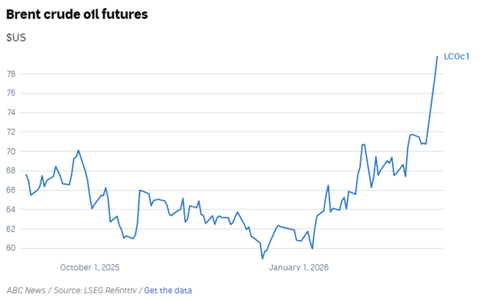
Source: ABC News
Experts predict that prices may reach $100 per barrel or higher, with some forecasts suggesting Brent crude could surpass $120 per barrel in extreme scenarios.
Prolonged airfreight disruption
Selected airlines, including Emirates SkyCargo, Qatar Airways Cargo, and Etihad Cargo, have resumed flights on a limited scale, with Emirates on 2 March communicating, “Emirates has begun operating a limited number of flights commencing on the evening of 2 March. As part of this phased resumption, we are prioritising clearing the cargo that is on hand. All other flights remain suspended until further notice. In line with this, we are maintaining temporary restrictions on the booking and acceptance of all new shipments until we have further clarity on the operational schedule”.
Passenger flights by in large remain suspended, and the majority of flights have so far serviced the evacuation of stranded passengers in the region. As highlighted on earlier occasions, then an important fact is, that majority of global air cargo is carried on commercial passenger flights as belly-hold cargo.
Experts estimate the situation could remain chaotic for several weeks as airlines assess alternate routes. Dr Ian Douglas, an expert in aviation and airline management, said the situation will be “messy for the next month for passenger flights at best, as airlines work to rebook passengers people, coordinate with partners and figure out other routes to avoid problematic airspace as a significant share of global cargo normally moves in passenger aircraft belly holds, meaning reduced passenger operations again is adding pressure to capacity and longer transit times”
Airspace remains closed or highly restricted in most of the Gulf countries, including the UAE, Qatar, Iran, Iraq, Kuwait, and Bahrain, significantly affecting global airfreight.
Majority of airlines are extending airspace suspensions, and furthermore, many airlines have cancelled or suspended flights two to three weeks out, hinting that the disruption will continue beyond this week, recognising the timeline laid out by the US Administration.
“We shouldn’t expect a wide return to normal in the Gulf region when there are still air attacks taking place. Once there’s more clarity, some of the region’s airlines will move quickly back to normal while the big connecting carriers like Emirates and Qatar Airways may take a few days to get all aircraft and crews back into sync and be fully operational,” ASM Aviation Consulting Director Edmond Rose said. “They may also be cautious about bringing full capacity back quickly while they assess any changes in market demand resulting from the war.”
Total capacity on Asia-Europe impacted by up to 40 %
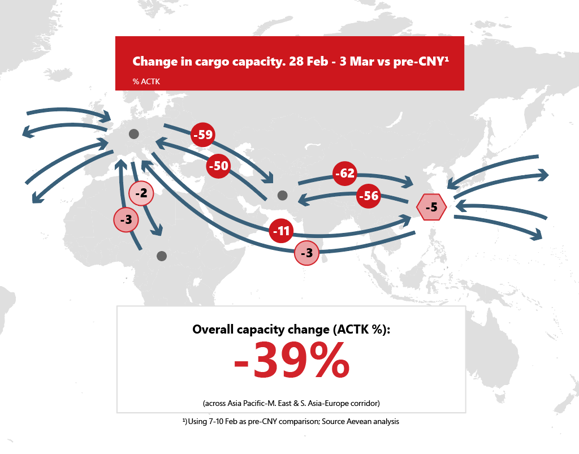
From a total capacity perspective on the blockbuster route from Asia to Europe estimates vary, however, consensus remains around the 35-40 % mark in terms of reduced capacity. Using representative pre-lunar new year levels as a baseline, consultancy Aevean, estimates that capacity across the Asia Pacific–Middle East and South Asia – Europe corridors is down by 39 % in available cargo tonne kilometres.
This number speaks to a fundamental, structural change in the global airfreight market in the short term.
Accordingly, rate levels have surged instantly, and we expect this development to persist in the coming weeks as backlogs have built quickly. We are doing our utmost to keep the additional cost impact to a minimum, recognising the severity of the situation.
Source: https://www.scangl.com/news/important-notice-update-on-the-ongoing-middle-east-security-situation/