

What are the alternative solutions at hand?
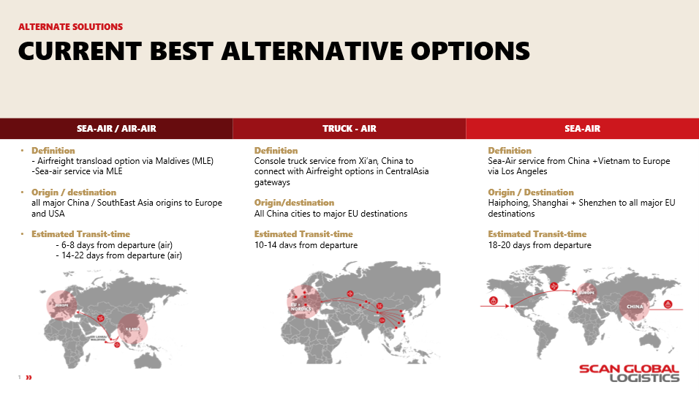
On the airfreight side, we have already seen a surge in requests for alternatives, namely Sea-Air and part & full charter options. Below you will find an overview of alternative routings across modes, and should you wish to explore these further, please reach out to your dedicated SGL contact person.
We are exploring all options to provide entrepreneurial alternatives to expedite shipments, and we are working on further solutions as we speak.
Ocean Freight disruption heating up
In terms of ocean freight, the disruption game is heating up, with the first signs of equipment imbalance as a challenge, and, not least, a reduction in available capacity due to idling vessels in the Gulf region.
According to Alphaliner, nearly 140 container vessels are trapped inside the Middle East Gulf, with MSC and CMA CGM being the most affected carriers, with 15 (109.000 TEU) and 14 (70.000 TEU) vessels, respectively, seeking shelter.
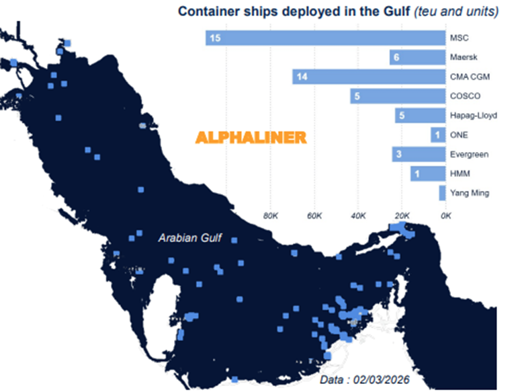
Source: Alphaliner Newsletter 2026-09
Alphaliner has recorded 124 container liner services calling to at least one port in the Arab Gulf as part of their proforma rotations. This amounts to 3.60 MTEU of combined deployed capacity across 520 container vessels. Concretely, the ongoing conflict in the Middle East has a direct impact on 10.7% of the global container shipping fleet based on available TEU capacity.
Significant rate increases ahead
Short-term rate levels are expected to spike, and on long-term rates, carriers have, for now, suspended contract negotiations. Hefty war risk surcharges to the tune of USD 2000-3000 per container have been imposed on shipments enroute to and from the Middle East. For new shipments, majority of carriers have suspended booking acceptance, except for cargo commodities such as food supplies and medicine.
In light off the critical situation, carriers have declared force majeure and commenced offloading containers at the nearest feasible port. MSC have declared a so-called “end of voyage” which comes along with a price tag of additional USD 800/container.
Red Sea passage grinds to a halt
While Houthi rebels have yet to officially declare their intentions following the attacks on Iran by Israel and the US, container carriers have commenced rerouting around the Cape of Good Hope, for now putting a stop to a return to the Red Sea and Suez Canal. The attacks on Iran could not have come at a worse time for global shipping, considering that it coincides with container carriers returning to Red Sea and Suez Canal passage.
Although there has been no official word of a resumption of Houthi attacks on commercial shipping, it has been reported that commanders had ordered the strait to be closed to shipping as Iran took similar action in the Strait of Hormuz.
“The repercussions of the joint military operation by the US and Israel against Iran and subsequent retaliatory action will see the further weaponization of trade and shatter hopes of a largescale return of container shipping to the Red Sea in 2026,” commented Peter Sand, chief analyst at Xeneta
Sand’s comments were swiftly followed by the Gemini Cooperation, which confirmed the reversal of its recent decision to re-route its ME11/IMX service from India to the Mediterranean via Suez. Maersk had also planned to re-route its MECL service, operating from India, the Middle East and the US East Coast, via Suez, but has also cancelled these plans.
As is the case with airfreight, it is clear that impact is spreading far beyond the Middle East. The COVID-19 period painfully showed just how interconnected and fragile the shipping ecosystem is, and this is still the case. One week of direct impact can easily translate into more than a month of structural disruption, including increased port congestion, equipment imbalance due to empty repositioning being out of sync, and, not least, reduced capacity.
Professor Ben Fahimnia, who specialises in supply chains and transport logistics at the University of Sydney states: “Re-routing ships adds time, cost, and obviously there is also the risk,” he says and continues, “so this prolonged disruption is something that would place sustained pressure on the energy market and global freight rates.” And also states: “If 20 per cent of globally traded supply is disrupted, then the price rises everywhere.”
Our recommendation for Gulf region ocean shipments
UAE import shipments:
Cargo bound for the UAE can be routed via Khorfakkan Port. This will ease the customs process, as the final destination remains within the UAE, making clearance more straightforward and efficient.
UAE export shipments:
For shipments from the UAE to the rest of the world, bookings can currently be moved through alternative ports, such as Sohar, Jeddah, and Khor Fakkan, but this is subject to carrier acceptance.
Saudi Arabia import shipments:
For shipments destined to Saudi Arabia, we recommend utilising Jeddah, King Abdullah Seaport, and Yanbu as the port of entry. This will simplify the customs process and facilitate smoother inland delivery within Saudi Arabia.
Saudi Arabia Exports:
All exports are, for now, transhipped normally from the Jeddah, King Abdullah, and Yanbu ports, though subject to an ECS surcharge.
Other GCC Countries Imports (Kuwait / Bahrain / Qatar / Oman):
For the remaining Gulf destinations, alternative ports are Sohar, Jeddah and Khorfakkan; however, the situation is currently very fluid, and all bookings are for now subject to final confirmation.
Navigating uncertainty is our top priority
We wish to underline that we are working around the clock to provide full transparency on delayed shipments and, accordingly, identify alternative routing options.
The situation is extremely volatile and is changing by the hour. We encourage constant dialogue, especially on time-critical shipments where delays are not an option. While the impact is structural by nature, there are options that can be utilised.
We recognise the impact of the additional cost coverage required, and the aim is to keep the additional cost impact to a minimum; however, the situation is unprecedented, and the outlook for the short-term is unfortunately significant cost increases. We strive for an open and constructive dialogue on these matters and in advance thank you for your understanding.
Last, but not least, the safety of our colleagues on the ground in the Middle East is our top priority. At present, we can maintain normal customer service levels through contingency planning, and we expect this to continue as the situation progresses.
Source: https://www.scangl.com/news/important-notice-update-on-the-ongoing-middle-east-security-situation/